
Permaculture avoids the reactive use of pesticides and replaces it with preventive system design. The push-and-pull principle is the most effective tool for this: repelling plants keep pests away from crops, while attracting plants draw them into controlled areas or concentrate beneficial organisms that regulate pest pressure. This article explains the biological mechanisms, derives specific plant combinations from the friend-foe matrix, and describes how to establish beneficial insect promotion as a long-term system strategy.
1. Why Chemical Pest Control Harms the System
Synthetic insecticides and fungicides rarely act selectively. Broad-spectrum insecticides kill pests and beneficial insects alike; the pest usually recovers faster because it has shorter generation times and its natural regulation system is weakened by the loss of beneficials. The result is pest resurgence: infestation is temporarily reduced after treatment but rises to a higher baseline level in the next generation than before.[1]
Furthermore, systemic pesticides damage soil life (Article 4), disrupt mycorrhizal networks, and harm pollinators, which are indispensable for fruit and vegetable garden yields. A meta-analysis by Woodcock et al. (2017) documented significant declines in wild bee populations near conventionally treated areas even years after the last application.[2]
2. Basic Principle: Tritrophic Interactions
The scientific foundation of the push-and-pull system is the tritrophic interaction: the interplay between plant (trophic level 1), pest (trophic level 2), and natural enemy (trophic level 3). Plants are not passive victims of pests but active participants in this network. When infested by pests, many plant species emit so-called herbivore-induced plant volatiles (HIPVs): volatile organic compounds that attract parasitic wasps, hoverflies, and predatory beetles from a distance.[3]
The push-and-pull system, first systematically developed by Khan et al. (1997) for African smallholder farmers, intentionally uses this principle: push plants emit compounds that repel or confuse pests; pull plants attract pests to a marginal area (trap crop) or concentrate beneficial insects through nectar and pollen offerings.[4]
| Mechanism | Effect | Example Plants |
|---|---|---|
| Push: Repellence | Volatile compounds confuse or repel pests; host plant is masked olfactorily | Basil, peppermint, thyme, sage, garlic, lavender |
| Push: Antifeedant | Plant compounds inhibit feeding; pests attack treated or neighboring plants less | Tansy, mugwort, wormwood, neem tree (outside USDA 7–8) |
| Pull: Trap Crop | Preferred host plant at the margin concentrates pests; manual or biological control there | Nasturtium (aphids), elderberry (aphids), black nightshade (Colorado potato beetle) |
| Pull: Beneficial Habitat | Nectar- and pollen-rich flowers feed hoverflies, parasitic wasps, lacewings | Dill, fennel, marigold, borage, phacelia, cornflower |
| Pull: Beneficial Overwintering | Structure-rich areas provide winter quarters for beneficial insects | Deadwood piles, perennial stubble, brush piles (Zone 5) |
3. The Most Important Pests and Counter-Strategies
Aphids attack most vegetable and herb species and are actively protected from beneficials by ants (honeydew symbiosis). Natural enemies are ladybugs, hoverflies (larvae), lacewings (larvae), parasitic gall midges, and parasitic wasps of the genus Aphidius.
Push: Plant basil, peppermint (potted), lavender, garlic between vulnerable crops.
Pull: Nasturtium as a trap crop at the bed edge; leave aphid colonies on the trap crop until hoverflies and ladybugs discover them. Only cut and compost the trap crop in case of massive infestation.
Beneficial Promotion: Dill, fennel, marigold, and phacelia as umbellifers for parasitic wasps and hoverflies in the bed surroundings.
Cabbage white butterflies (Pieris brassicae, P. rapae) and cabbage moths (Mamestra brassicae) lay eggs preferentially on brassicas. The larvae eat leaf mass and can completely destroy young plants. Natural enemies: parasitic wasps of the genus Cotesia (parasitize cabbage white caterpillars), ground beetles (eat pupae in the soil).
Push: Thyme, sage, rosemary, and peppermint between cabbage plants; their essential oils overlay the cabbage odor and make host plant finding more difficult for moths.
Pull: Nasturtium and mustard as trap crops at the bed edge; nasturtium is preferentially visited by cabbage white butterflies.
Mechanical: Fine-mesh netting (mesh size 1.3 mm) over young plants in the first four weeks; afterward, plants are more resilient. Regularly check for eggs (yellow clusters on leaf undersides).
The carrot fly lays eggs at the soil base of carrots, parsnips, and parsley. The larvae eat tunnels into the roots; infested carrots are unsellable and cannot be stored. Two generations per year (May–June and August–September); the damage from the second generation is often more severe.
Push: Carrots and leeks or onions in alternating rows (classic combination from Article 3); the onion odor demonstrably overlays the carrot odor and prevents egg-laying.[5]
Timing: Early sowing (March) yields harvest before the peak of the first generation; late sowing (July) yields harvest before the peak of the second. Bridge the main infestation periods May–June and August–September without fresh sowings if possible.
Mechanical: Fleece cover (insect netting) from sowing to harvest; the fly cannot lay eggs.
Whitefly mainly attacks tomatoes, cucumbers, peppers, and cabbage species. It excretes honeydew, which promotes sooty mold. Natural enemy in the field: parasitic wasp Encarsia formosa (also available commercially as a biological control agent); sufficiently present in the field if beneficial habitats are maintained.
Push: Basil next to tomatoes and cucumbers; marigolds (Tagetes patula) as bed companions; lavender at greenhouse openings.
Pull: Yellow sticky traps at the bed edge mechanically catch adult flies; no insecticide use necessary.
Parasitic roundworms of the genus Meloidogyne (root-knot nematodes) attack a wide range of crops and cause growth inhibition and root galls. They are persistent in the soil and difficult to control by crop rotation alone.
Push: Marigold species (especially Tagetes patula and T. erecta) release thiophenes through their roots that kill or inhibit parasitic nematodes. For effective nematode reduction, marigolds must be grown as a dense cover crop on the affected area for at least a full season, not just as a companion plant.[6]
Biological: Steinernema nematodes (predatory nematodes) can be applied as a preparation and parasitize pest nematodes; effective at soil temperatures above 12 °C.
Slugs, particularly the Spanish slug (Arion vulgaris), are among the most serious pests in temperate humid climates (USDA Zone 7–8). Their population dynamics are closely linked to weather; wet, warm springs lead to mass outbreaks.
Structural: Actively promote hedgehogs, ground beetles, toads, and ducks (Khaki Campbell duck as slug hunter) as beneficials. Create structure-rich Zone 5 areas and deadwood piles as ground beetle habitat.
Push: Pungent or aromatic plants as border beds: garlic, sage, rosemary; slugs avoid strongly aromatic environments. Coffee grounds around young plants as a mechanical barrier.
Mechanical: Slug fences made of copper tape or 15 cm high smooth sheet metal; manual collection in the early morning hours (peak slug activity); traps with beer or yeast water.
4. Promoting Beneficial Insects as a Long-Term Strategy
The crucial difference between reactive pest management and the permaculture approach lies in perspective: Instead of solving individual pest problems, a system is built in which beneficial populations are permanently present and active. This requires three conditions: year-round food supply, overwintering structures, and a pesticide-free environment.
| Beneficial | Regulates | Food (adult) | Habitat Requirement |
|---|---|---|---|
| Ladybugs | Aphids, scale insects | Aphids, pollen | Hollow stems, deadwood, perennial stubble as winter quarters |
| Hoverflies | Aphids (larvae) | Nectar and pollen (adult) | Umbellifers: dill, fennel, parsley, wild carrot |
| Parasitic Wasps | Caterpillars, aphids, whitefly | Nectar, honeydew | Umbellifers, trap crop aphid colonies as host insects |
| Lacewings | Aphids, spider mites, thrips (larvae) | Nectar, pollen, honeydew (adult) | Lacewing hotels; dense perennial vegetation |
| Ground Beetles | Slug eggs, flea beetles, butterfly larvae | Small animals, seeds | Near-ground structures: stones, deadwood, mulch layers |
| Common Toad | Slugs, insects, worms | Slugs, insects | Moist hiding places; shallow water basin for spawning |
| Wild Bees | Pollination (indirect yield security) | Nectar and pollen | Flower strips; nesting aids (perforated bricks, bamboo tubes, sandy areas) |
4.1 Flower Strips and Beneficial Insect Islands
Flower strips are narrow, permanently planted areas within or at the edge of the vegetable garden that ensure a continuous supply of pollen and nectar from March to October. The temporal staggering is crucial: spring bloomers (crocus, primrose, comfrey) feed bumblebees and hoverflies before the vegetables have grown; summer bloomers (marigold, borage, phacelia, coneflower) bridge the main season; autumn bloomers (marigolds, asters, stonecrops) still provide food until the first frost.[7]
4.2 Structural Elements for Overwintering
- Deadwood pile (Zone 5): At least 1 m³ made from branches of varying thickness; ground beetles, hedgehogs, shrews overwinter in it.
- Leave perennial stubble: Do not cut hollow stems of thistles, elderberry, valerian, and coneflower until March; overwintering site for lacewings and solitary wild bees.
- Leaf pile: Dry leaves in the northeast corner (Zone 5) as hedgehog quarters and ground beetle habitat.
- Nesting aids for wild bees: Bundles of bamboo tubes (inner diameter 2–10 mm), perforated bricks, sandy soil areas for ground-nesting species; orient southeast.
- Water sources: Shallow dishes with gravel bottom and clean water; refresh daily; prevents mosquito breeding and provides drinking water for insects and birds.
- Bird nesting boxes: Tits eat several hundred insects and caterpillars daily; nesting boxes with 32 mm entrance hole for great tits, 28 mm for blue tits.
5. Push & Pull from the Friend-Foe Matrix
The friend-foe matrix evaluated in Article 3 provides direct derivations for push-and-pull combinations. Positive values (1) between a crop plant and an herb or flower species typically arise from one or more of the following mechanisms: repellence, beneficial attraction, olfactory masking, or trap crop effect. The following table translates selected matrix values into functional push-and-pull assignments.
| Crop Plant | Push Partner | Pull Partner | Pest (Target) |
|---|---|---|---|
| Tomato | Basil, sage, peppermint | Nasturtium, marigold, Tagetes | Aphid, whitefly, nematodes |
| Cabbage (all types) | Thyme, sage, rosemary, dill | Nasturtium, mustard | Cabbage white butterfly, flea beetle, aphid |
| Carrot | Leek, onion, rosemary | Dill (parasitic wasps) | Carrot fly |
| Bean | Summer savory | Nasturtium, borage | Black bean aphid, spider mite |
| Cucumber | Dill, borage | Nasturtium, marigold | Aphid, spider mite, powdery mildew |
| Strawberry | Garlic, onion, sage | Borage (pollinators) | Gray mold, strawberry mite |
| Bell Pepper | Basil, Tagetes | Marigold | Aphid, whitefly, spider mite |
| Pumpkin / Zucchini | Nasturtium (Push at edge) | Borage, marigold (pollinators) | Aphid, cucumber mosaic virus (aphid-borne) |
6. Systemic Monitoring: Observation Instead of Reaction
A functioning push-and-pull system requires regular observation, not regular treatment. The goal is not the eradication of all pests, but the balance between pest and beneficial populations. Some pest pressure is desirable: it keeps beneficial populations active and prevents them from migrating away due to lack of food.[8]
- Check leaf undersides on five randomly selected plants per bed for eggs, larvae, and aphids.
- Observe the trap crop (nasturtium) for aphid infestation and beneficial presence (ladybugs, hoverflies).
- Check umbellifers (dill, parsley in bloom) for parasitic wasps and hoverflies; their presence indicates system health.
- Map slug damage; concentration in specific areas indicates structural gaps (moist spots, missing barriers).
- Record findings: date, pest, infested plant, damage level (1 = occasional, 2 = widespread, 3 = massive), beneficial sightings.
Interventions are only indicated from damage level 2 on more than 20% of plants of a species. At damage level 3, mechanical measures come first (hand-picking, washing off, netting), biological agents (neem oil, potassium soap, Steinernema nematodes) only as a last resort and exclusively targeted — never area-wide.
7. Outlook
Article 7 introduces the interactive plant selection tool, which is based on the friend-foe matrix (Article 3) and the push-and-pull assignments from this article. Users can filter by location, USDA zone, available space, and pest risk, and receive a selection of compatible crop plants and companion plants with a planting calendar.
References and Sources
- Pedigo, L. P. & Rice, M. E. (2009). Entomology and Pest Management. 6th Ed. Pearson, Upper Saddle River.
- Woodcock, B. A. et al. (2017). Country-specific effects of neonicotinoid pesticides on honey bees and wild bees. Science
- Turlings, T. C. J. & Erb, M. (2018). Tritrophic interactions mediated by herbivore-induced plant volatiles. Annual Review of Plant Biology
- Khan, Z. R. et al. (1997). Intercropping increases parasitism of pests. Agriculture, Ecosystems & Environment
- Finch, S. & Collier, R. H. (2000). Host-plant selection by insects. Entomologia Experimentalis et Applicata,
- Hooks, C. R. R. et al. (2010). Using marigold as a cover crop to protect subsequent vegetable crops from root-knot nematodes. Applied Soil Ecology
- Haaland, C. et al. (2011). Wildflower strips for wild bees and other invertebrates. Ecological Engineering
- Altieri, M. A. & Nicholls, C. I. (2004). Biodiversity and Pest Management in Agroecosystems. 2nd Ed. Food Products Press, New York.
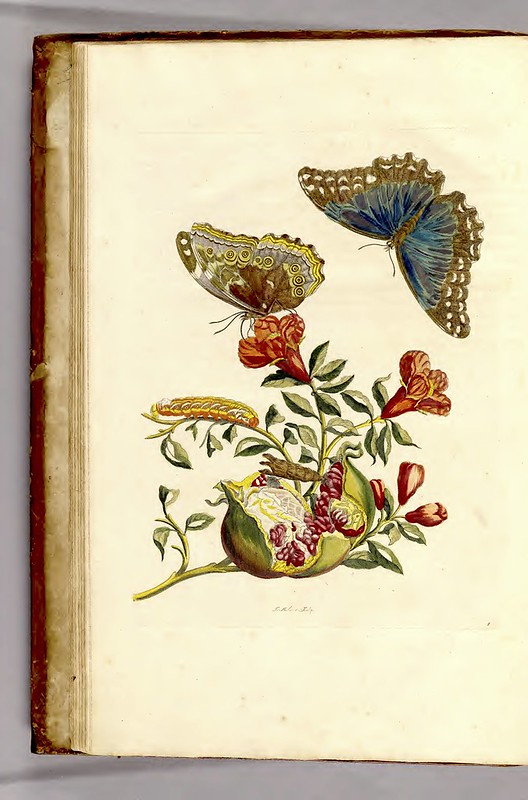
- Image: Pomegranate with Blue Morpho Butterflies and Banded Sphinx Moth Caterpillar (1705), Merian, M.S., Metamorphosis insectorum Surinamensium, Plate IX (1705)


Add Comment