
The Problem
With biofilters in aquaponics, there is a fundamental problem: If you place fish in a new system, there are no bacterial colonies on the substrate yet that can clean the water of ammonia. Without this cleaning, the fish will eventually poison themselves. However, without fish, bacteria will not form either, as they find no food (ammonia) in the clean water. To better estimate the capacity of a necessary biofilter, we have created a small calculator for you here.

The Solution
Before fish are introduced into the system, add ammonia in a controlled manner. The following items are sufficient for this:
- Test strips for pH value (available from aquarium supply stores)
- Test for ammonia content of the water (available from aquarium supply stores)
- Ammonia solution (pharmacy)
- Vinegar if the water becomes too basic (supermarket)
Regarding Ammonia: Please be sure to wear protective gloves, respiratory protection, and safety goggles when using it.
Biofilter Carriers
Most biofilters use media such as sand, gravel, river pebbles, or some form of plastic or ceramic material in the shape of small beads and rings.
A main problem when operating a biofilter is preventing localized drying out or waterlogging of the filter material, thereby allowing uniform flow through the filter bed. This can be achieved primarily by encapsulating the biofilter. Disadvantages are often the large space requirement of these systems, the costly fan energy for pressure increase, and the continuous irrigation. Compared to other methods, such as ionization with ionization tubes, the constant biological cleaning method is often advantageous due to CO2 savings and numerous economic aspects, such as moderate initial costs, long filter service lives, and moderate operating costs.
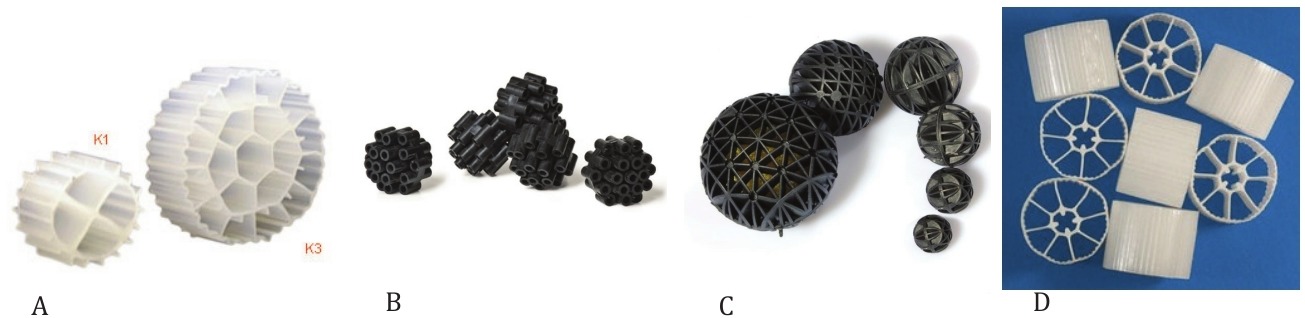
Commercial Biofilter Media (SSA: Specific Surface Area): (A) K1, K3, (B) Atlantic Bio-Balls, (C) Honeycomb Bio-Balls, and (D) MB3 Media.
Procedure (according to Bernstein, 2011)
- Plant the system.
- Add ammonia until 2-4 ppm are reached. Note the amount used. For a tank of approx. 600 l, you need about 75ml of 25% ammonia solution.
- Add this amount daily until at least 0.5 ppm of nitrite is measurable in the water. If the ammonia level approaches 8 ppm, wait with further ammonia additions until it drops back to 2-4 ppm. Since the increase can be quite rapid, a higher dosage is not advisable.
- As soon as nitrite appears in testing, cut the ammonia additions in half. If the nitrite level exceeds 5 ppm, stop adding ammonia entirely until the level drops to 2 ppm.
- Once nitrate reaches 5-10 ppm, wait until nitrite and ammonia levels return to zero. Then you can introduce fish.
- The pH value should be between 6.8 and 7.0. If the value is too basic (Basic = towards pH 14), correct carefully with vinegar. If the value is too low (Acidic = towards pH 1), correct with calcium carbonate/soda - of course before the fish are introduced. Keep in mind that the EC value will rise due to the additional dissolved salts.
What happens in the biofilter during this process?
By adding ammonia, bacteria that convert ammonia into nitrite find food. This nitrite then serves as an energy source for other microorganisms. The oxidation of nitrite (NO2) produces nitrate (NO3). This process is the second step in the nitrification of ammonia (NH3) to nitrate. The nitrate then serves as fertilizer for the plants.
The Nitrification Process in Aquaponics
Ammonia ⇒ Nitrite ⇒ Nitrate
Nitrifying bacteria play an important role in an aquaponics system. They convert fish waste, so that ammonia enters the system as nitrate. Nitrification in aquaponics is a two-step process and involves two nitrifying bacteria:
1. Conversion of Ammonia to Nitrites: This is carried out by Nitrosomonas. When there is an overload of waste, it produces excess ammonia. The ammonia must be removed to avoid harming the fish. The Nitrosomonas bacteria then convert the ammonia into nitrites.
2. Conversion of Nitrite to Nitrate: This is carried out by bacteria of the class Nitrobacter. Nitrobacter bacteria feed on nitrites. The nitrites are converted into nitrates. Excessive amounts of nitrite can kill the fish. To keep the fish and plants healthy, nitrites must be converted into nitrates.
Nitrifying bacteria reproduce slowly and form colonies; it can take days, weeks, or even months. Nitrifying bacteria require a dark location, good water quality, and sufficient food and oxygen to settle. There are five key parameters to support nitrifying bacteria. If these parameters are maintained, it is assumed that the bacteria are present.
1. Large Surface Area
Biofiltration with a high specific surface area is important for developing extensive colonies of nitrifying bacteria. There are many materials that can be used in aquaponics, either as a growing medium or for biofiltration. Volcanic gravel, expanded clay pebbles, commercial plastic biofilter balls, and not least plant roots act as surfaces on which bacteria can settle. The smaller and more porous the particles, the larger the surface area available for bacteria to colonize, which in turn leads to more efficient biofiltration.
2. Water pH Value
Nitrifying bacteria function properly when the pH is between 6 and 8.5. The ideal pH in aquaponics is usually 6-7. This is a compromise between all organisms in the system.
3. Water Temperature
The ideal temperature range for the bacteria is between 17° Celsius and 34° Celsius (~63° Fahrenheit - 93° Fahrenheit). This range promotes bacterial growth and productivity. If the water temperature drops below this range, bacterial productivity decreases. If it rises significantly above it, i.e., above 42° Celsius, the bacteria die.
4. Dissolved Oxygen
Nitrifying bacteria require a sufficient level of dissolved oxygen in the water to grow and maintain the necessary productivity. The optimal dissolved oxygen level is above 7 ppm; nitrification will not take place if the dissolved oxygen concentration drops below 7.0 ppm. You can ensure adequate biofiltration and dissolved oxygen by adding aeration (vortex systems) or air stones, for example. Oxygen levels can also be increased through flood-and-drain cycles.
5. No UV Light
Nitrifying bacteria are sensitive to light until they are fully established. Sunlight can damage the biofilter. Media beds protect the bacteria from sunlight. If you use a biofilter, be sure to protect it from direct sunlight and excessive heat.
Undesirable Bacteria
Nitrifying and mineralizing bacteria are important and useful for aquaponics, but there are some types of bacteria that are harmful to an aquaponics system. These include:
1. Sulfate-Reducing Bacteria
These bacteria are often found under anaerobic conditions and smell like rotten eggs. These bacteria have a gray-black color and grow only under anoxic conditions. It is important to ensure adequate aeration and increase mechanical filtration to prevent the accumulation of these bacteria.
2. Denitrifying Bacteria
These bacteria also thrive under anaerobic conditions and are responsible for denitrification. They convert nitrites back into atmospheric nitrogen, which is not available to plants. These bacteria can reduce efficiency by removing the nitrogen fertilizer.
3. Pathogenic Bacteria
These bacteria can cause diseases in plants, fish, and humans. It is important to have good practices (CMMI) to minimize the risk of disease in an aquaponics system. You can prevent the introduction of pathogens into the system by keeping all other animals (pets, livestock, etc.) away from your system. If you set up your aquaponics system in a closed greenhouse, you can also prevent pathogenic bacteria from entering your system.
System Cycling and Establishing a Biofilter Colony
"System cycling" in aquaponics refers to the formation of a healthy bacterial colony when you start your new aquaponics system. The process takes place once a new aquaponics system is built and usually takes 4 weeks up to two years - depending on the scale of the system and many other factors. The process involves introducing an ammonia source (usually fish) into a new aquaponics system, feeding the new bacterial colony, and building up the biofilter (by the bacteria themselves). Progress is measured by monitoring nitrogen levels.
Without bacteria, the nitrogen cycle does not take place. The nitrogen cycle converts the ammonia from fish waste into fertilizer for plants. The nitrogen cycle only takes place if nitrifying bacteria are present. For this to happen, ammonia must be added to the system. This ammonia can be added with the fish or with water from another aquaponics system in which the bacterial colony is already established. When more ammonia is added, more bacteria are produced, making the system more efficient. Once ammonia-converting bacteria become established, they produce nitrites, which allow the bacteria that consume nitrites to produce nitrates from them. A system is fully established (cycled) once ammonia, nitrites, and nitrates are measurable through testing.
This procedure is often used in new aquaponics systems because it can be carried out without concerns regarding the safety of the fish. To start the system, you need to introduce ammonia into the system.
The process is simple; after the system is set up, begin adding the ammonia solution to the water. Once the system (tank, pumps, etc.) has been fully circulated, you should have reached a value of at least 0.2 ppm.
Ways to Reduce System Cycling Time
The system cycle is a very slow process. Depending on the system size and type, the process can take up to 18 months. However, there are other ways to cycle the system faster. One method is to use water from another aquaponics system in which the bacterial colony is already established. It is helpful to transfer part of the biofilter as a bacterial starter to a new aquaponics system. This reduces the time required to cycle the system. Some users prefer to add a little urea or a dead fish to the tank to start the decomposition process. However, be mindful of the formation of pathogenic bacteria - you must avoid these. Household ammonia can also be used. However, make sure the product is 100 percent ammonia and contains no other ingredients such as cleaning agents or heavy metals that could damage the entire system.
Once the ammonia and nitrite levels are below 1 ppm, you can add plants and fish to the system. Start with a few fish and monitor the nitrogen levels closely. Be prepared for a water exchange if the ammonia or nitrite level rises above 1 ppm while the system continues to run.
Bacteria are just as important as the fish and the plants in an aquaponics system.
Add Comment