 Borgmann Aquaponics Hydroponics


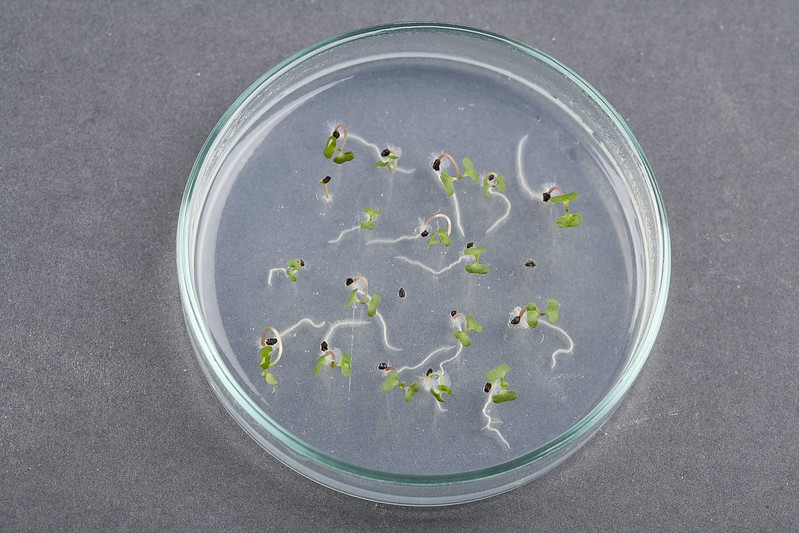 Agar is a natural gelling agent derived from the cell walls of certain red algae (e.g. B. Gelidium or Gracilaria) is won. In plant-cell breeding, agar serves as a carrier medium for nutrients and hormones that promote the growth and differentiation of plant cells in vitro.
Properties and functions
- gelling agent: Agar solidifies at about 40 °C and only melts at about 85–90 °C. This makes it ideal for stabilizing culture media.
- Nutrient carrier: Serves as a matrix to contain water, macro- and micronutrients, sugars and plant growth regulators (e.g. B. Auxins, cytokinins) to be made equally available.
- inert: Agar does not react chemically with medium components and is largely inert to plant cells.
applications
- Micropropagation (z. B. Cloning plants via meristems)
- Callus induction (Wound tissue for regeneration)
- Somatic embryogenesis (Development of whole plants from single cells)
- Gene transformations (z. B. Agrobacterium tumefaciens-mediated transformations)
Standard nutrient medium with agar (Murashige & Skoog + agar)
Suitable for most herbaceous plants in in vitro culture.
Ingredients (for 1 liter of medium)
|
component |
quantity |
|---|---|
|
Murashige & Skoog (MS) Basal Salt |
4.43 g |
|
Sucrose (sugar) |
30 g |
|
Agar (plant tissue culture grade) |
7–8 g |
|
Adjust pH to |
5.7 – 5.8 |
|
Optional: Plant hormones |
depending on the purpose |
|
– Benzylaminopurine (BAP, cytokinin) |
0.5–2.0 mg/L |
|
– Indole-3-acetic acid (IAA) or NAA |
0.1–1.0 mg/L |
preparation
- Water (approx. 800 ml) Put it in a beaker.
- MS basal salts and sucrose completely solve it.
- If necessary: Plant growth regulators (hormones) to give.
- If sensitive to heat: add aseptically only after autoclaving.
- pH value with NaOH or HCl on 5.7–5.8 set.
- agar Stir in (preferably with a magnetic stirrer). 6 - 8 g/L, see table below
- Volume with distilled water on 1 liter refill.
- Pour the medium into suitable containers (e.g. B. Culture vessels or Erlenmeyer flasks).
- Autoclaving at 121 °C and 1 atm positive pressure for 15–20 minutes.
Recommended dosage
|
Agar concentration |
Consistency of the medium |
application |
|
6 g/L |
soft to medium firm |
sensitive cultures, e.g. B. Rooting |
|
7 – 8 g/L |
normal firm |
Standard for micropropagation, callus formation |
|
> 8 g/L |
very firm |
e.g. B. for highly water-absorbing or heavy explants |
notice
- Not too firm: Agar concentrations that are too high can limit water and nutrient availability.
- Not too soft: Too low concentrations result in unstable media, making storage and cultivation difficult.
Sources, among others
- Murashige, T, & Skoog, F. (1962). A revised medium for rapid growth and bio assays with tobacco tissue cultures. Physiologia Plantarum, 15(3), 473–497.
DOI: 10.1111/j.1399-3054.1962.tb08052.x - George, EF, Hall, MA, & De Klerk, G.-J. (2008). Plant Propagation by Tissue Culture (Vol. 1, Springer), pp. 115–122.
Availability & Costs: Commercial plant tissue agar is known as plant tissue culture grade available. In terms of price, it varies depending on purity and supplier.
Literature reference
- George, EF, Hall, MA, & De Klerk, G.-J. (2008). Plant Propagation by Tissue Culture (Vol. 1 & 2). Springer.„Agar is the most widely used gelling agent for plant tissue culture. Its inertness, high gel strength and transparency make it a standard medium component in most protocols.“ (Vol. 1, p. 115)
- Thorpe, TA (2007). History of plant tissue culture. Molecular Biotechnology, 37(2), 169–180.
DOI: 10.1007/s12033-007-0031-3 - picture: Eucalyptus seeds on agar in a Petri dish.. https://www.flickr.com/photos/botanic-gardens-sydney/4167463471, CC BY-NC-ND 2.0
Add Comment