
Facts - Coriander
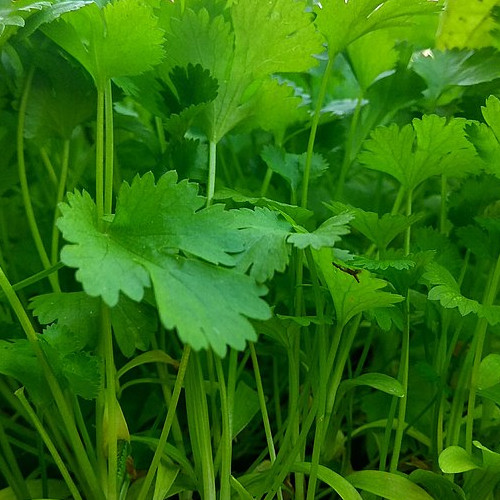
Cultivation
- Coconut soil
- Peat-free potting soil
- Hemp mats
- spray surface with water sprayer in the morning and evening
Nutritional values per 100g
Steps of cultivation
- If you soak the seeds, place them in a bowl of plain water for 12-24 hours
- Prepare growth medium and generously moisten the surface
- Distribute seeds evenly and avoid partial accumulations, coriander requires a lot of space, approx. seeds per cm²
- Moisten the seeds extensively with a water sprayer
- Cover with any cover and weigh down (e.g. two baking stones), store in a dark place
- Germination occurs in 2 - 6 days
- Remove cover and transfer to aquaponics system. After 10 to 20 days, the mature microgreens can be harvested
- Harvesting should take place in the morning or evening due to cooler temperatures
Coriander (cilantro) microgreens present specific cultivation challenges due to their spherical seeds that readily retain seed coats after germination, reducing market quality. Monogerm coriander varieties are recommended for microgreen production as they germinate approximately one day faster than standard types and shed seed coats more readily. Seeds should be sown at a density of 10-15 seeds per square inch at 6 mm (¼ inch) depth in well-draining, nutrient-rich media with pH 6.0-7.0. Optimal germination temperature is 24°C (75°F), reduced to 16-18°C (60-65°F) after emergence. Coriander requires moderate light exposure of 4-6 hours daily, which is lower than many other microgreens. Bottom watering is essential to prevent soil splash that can trap seed coats on developing leaves. Germination occurs within 2-5 days, with total production time of 10-14 days until harvest. Plants reach 6-10 cm height at maturity, with growth rates of approximately 2.5 cm per day under optimal conditions. Coriander microgreens are rich in vitamins A, C, and K, with the characteristic flavor fully developed at the cotyledon stage.
Image: https://commons.wikimedia.org/wiki
Context:
Add Comment